
What happens when location-independent work moves beyond cafés, co-working spaces and tropical beaches, towards places where connectivity, energy and even silence have to be designed?
For years, digital nomadism had a recognizable visual language.
A laptop.
A beach.
A co-working space somewhere warm.
The underlying idea was simple: if work could travel through the internet, perhaps the worker could travel too.
But I think the more interesting question begins one step later.
What happens when we stop designing work around location and start designing the infrastructure that makes work possible?
That takes us somewhere very different.
Sometimes as far as the northern edge of Europe.
Listen while reading:
Silent Code ❄️
The article, translated into music.
Infrastructure as the new level of freedom
Remote work separated certain kinds of work from the office.
Satellite connectivity, distributed energy systems, increasingly capable portable technology and new forms of small-scale architecture are beginning to separate some forms of living and working from traditional infrastructure as well.
That distinction matters.
Location independence asks: Where can I work?
Infrastructure independence asks: What does this place need so I can work from here?
Energy.
Connectivity.
Shelter.
Water.
A workable environment.
Once those components become more portable, distributed or self-contained, the map of possible workplaces changes.
This is already visible in experiments with off-grid living.
Finnish architect Pekka Littow’s Majamaja concept, for example, combines self-sustained green energy, rainwater collection, circular water treatment and compact living architecture. Its Helsinki archipelago retreat operates off-grid while its cabins still include a dining table that doubles as a work desk, running water, kitchen facilities and other basic infrastructure for temporary living and working.
It is a small example.
But it points towards a much bigger idea.
The workplace can become a system rather than a place.
The new remote-work stack
Think about a remote workplace as a stack.
Energy
Working somewhere only becomes possible when the devices, heating, lighting and communications infrastructure can operate reliably.
Distributed energy systems make increasingly self-contained environments possible.
Connectivity
Satellite internet has changed another part of the equation.
Connectivity can now reach locations where terrestrial broadband infrastructure would previously have made serious remote knowledge work difficult or impossible.
That doesn’t make every remote location a reliable workplace. Weather, coverage, latency, power supply and redundancy still matter.
But geography is becoming a different kind of constraint.
Environment
And then there is the component we discuss much less: attention.
A workplace is also an attentional environment.
Notifications, meetings, conversations, noise, visual stimulation and constant context switching all compete for a finite cognitive resource.
This makes the physical environment part of the infrastructure of knowledge work.
What if silence is infrastructure too?
This is where the Arctic cabin becomes more than an aesthetic idea.
Research into natural environments and cognition suggests that exposure to nature can have restorative effects on attention. A 2025 systematic review and meta-analysis covering 80 studies found greater overall cognitive restoration following nature exposure than non-nature exposure, with the clearest effects appearing in working memory and attentional control. The researchers also caution that effects vary substantially between studies.
So the interesting idea isn’t:
nature makes everyone more productive.
It is subtler than that.
The environment changes the conditions under which attention operates.
For some kinds of work, fewer interruptions and longer periods of uninterrupted concentration may be more valuable than constant accessibility.
And that changes how we might think about workplace design.
From remote work to environment design
Remote work discussions usually revolve around a familiar question:
office or home?
But that may already be too narrow.
Once work becomes digitally portable, we can start asking different questions.
What environment helps this particular work happen?
When do I need collaboration?
When do I need isolation?
How much connectivity do I actually need?
Which parts of my infrastructure need redundancy?
What physical conditions help me think?
This turns remote work into something more interesting than a location policy.
It becomes environment design.
The new meaning of “nomad”
The first generation of digital nomadism was primarily about mobility.
Move somewhere else and take the work with you.
The next evolution may be less about constant movement.
It may be about choosing and designing environments intentionally.
A city for collaboration.
A home for stability.
A train for transition.
A cabin for deep work.
A different country for a different chapter of life.
The future of location-independent work may therefore have surprisingly little to do with being permanently nomadic.
It may simply give us a larger set of environments from which to build a working life.
Silence as technology
And this brings me back to the idea behind Silent Code.
Technology usually enters the future-of-work conversation as something we add.
Another platform.
Another AI tool.
Another communication layer.
Another device.
But sometimes the most valuable thing technology can give us is the ability to remove something.
Distance.
Dependency.
Noise.
Interruption.
The paradox is interesting:
the more technology allows us to work from anywhere, the more valuable the ability to choose where our attention goes may become.
Perhaps silence belongs in the technology stack too.
Not as an escape from work.
As infrastructure for thinking.
Sources & further reading
Majamaja
Off-grid architecture, energy, water systems and cabin concept
Majamaja official website
Nature exposure and cognitive restoration
Effects of nature exposure on cognitive restoration: A systematic review and meta-analysis
2025 · Journal of Environmental Psychology / ScienceDirect
Satellite connectivity
Starlink · official information on satellite internet and service availability
FROM ARTICLE TO SOUND
SIGNAL 001 · SILENT CODE
ARTICLE
Infrastructure independence · Remote work · Environmental design
↓
SOUND
Isolation · Focus · Cold · Continuity
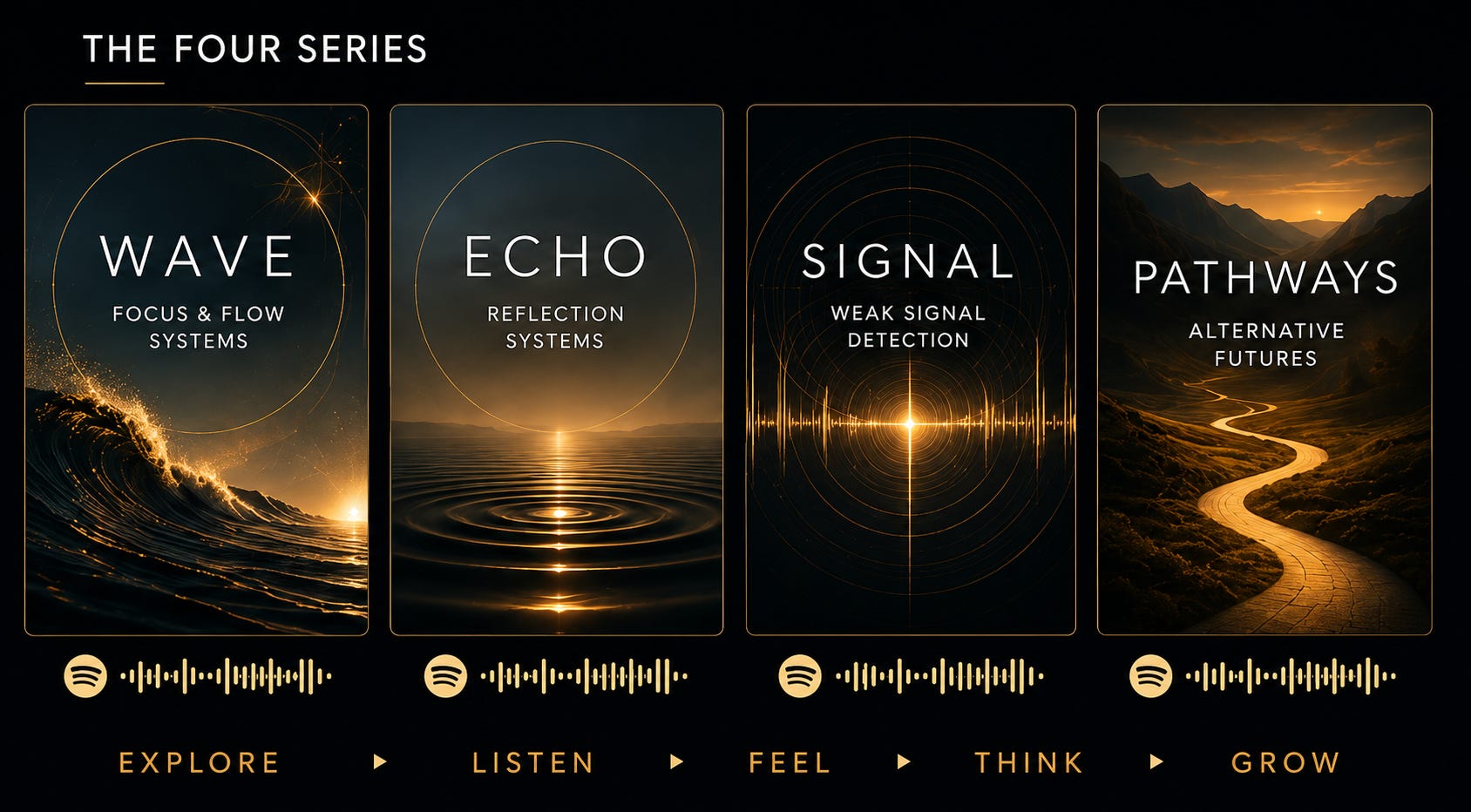
About SIGNAL
Ideas become sound.
SIGNAL turns selected articles and written ideas into original soundtracks.
Articles translated into music.
Continue with SIGNAL
Listen elsewhere
Spotify · Apple Music · YouTube Music · Amazon Music · Tidal
✨Future ideas. Articles. Soundtracks.