

I rarely begin with a solution. Usually, I begin with a question.
Something doesn’t quite make sense. A process feels unnecessarily complicated. An opportunity is difficult to see. Or two things that are treated separately seem to be connected.
Over time, I’ve realized that the subjects may change, but the way I approach them rarely does. Certain principles keep returning in the way I use systems thinking to understand problems, connect ideas and build systems.
They are not steps. They are simply the principles behind how I work.
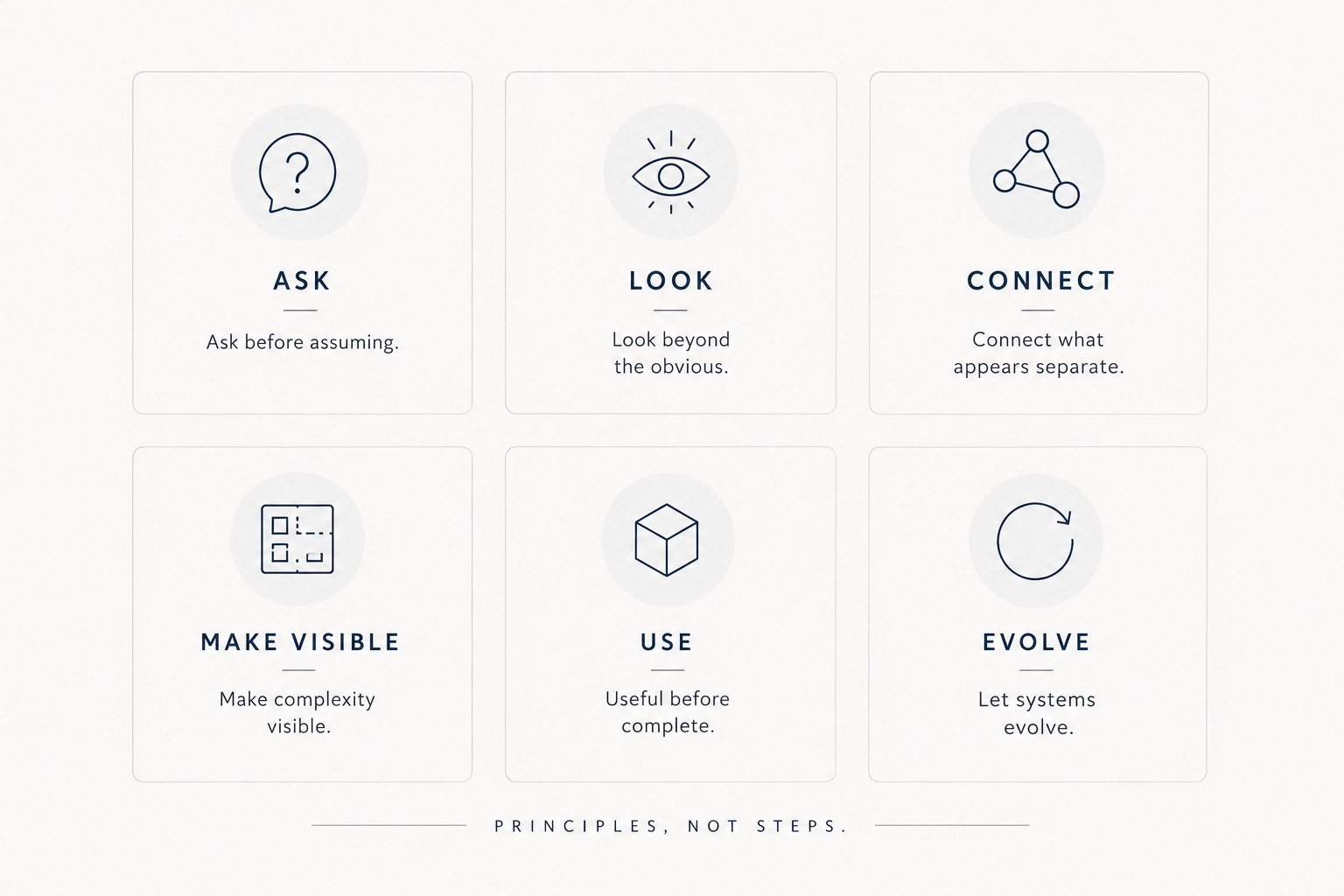
⦿ Ask before assuming.
The first problem we see is not always the problem we need to solve. Before thinking about solutions, I try to understand what is actually happening, what has changed, what we are assuming and what we might be missing.
A good question can change the way we see the problem.
⦿ Look beyond the obvious.
Problems rarely exist on their own. People, processes, information, technology and decisions influence one another.
Something that looks like a process problem may actually be an information problem. Something that looks like a technology problem may have more to do with the way people work.
Context can change the problem.
⦿ Connect what appears separate.
This is probably the principle that appears most often in my work.
People connect to processes. Skills connect to opportunities. Information connects to decisions. Technology connects to the way work gets done.
Ideas that initially seem unrelated can turn out to be different parts of the same system.
I’m particularly interested in those connections.
⦿ Make complexity visible.
Once I understand the relationships, I like to make them visible. That may become a map, framework, workflow, model, diagram or simply a clearer way of explaining how something works.
The format changes. The purpose doesn’t.
What becomes visible becomes easier to understand.
⦿ Useful before complete.
An idea doesn’t need to be finished before it can become useful.
I prefer to build enough to answer a real question, test an assumption or see how an idea behaves outside my head. Then I learn from it and develop what proves useful.
Useful before complete.
⦿ Let systems evolve.
Once something is used, new information appears. Assumptions change, new connections become visible and things that once seemed necessary may no longer be.
So I return, rethink, simplify and develop.
Iteration is part of how the idea evolves.
Principles, not steps.
These principles don’t happen in a fixed order. I may return to a question while building, discover a new connection while testing or simplify something long after it has already been used.
That is why I don’t think of this as a six-step methodology. It is simply a way of working.
From principles to process
These principles describe how I approach the work.
When an idea begins to take shape, the Systems Design Cycle provides the process for developing it:
Observe → Structure → Design → Improve → Explore ↺
→ Explore the Systems Design Cycle
Where I apply this thinking
The questions and outcomes change, but the underlying principles remain consistent.
Opportunity Systems → Careers, skills, learning and opportunity.
Business Systems → Organizations, operations and the structures behind them.
Workflow Systems → Processes, knowledge, technology and automation.
Future Systems → Emerging ideas, technology and new possibilities.
What comes from it
Not every question needs to become a project. Some remain observations or Field Notes. Others develop into frameworks, resources or projects that may eventually become case studies.
The outcome isn’t decided at the beginning. It emerges from what I learn along the way.
Understand what is really happening. Connect what belongs together. Build from what you learn.